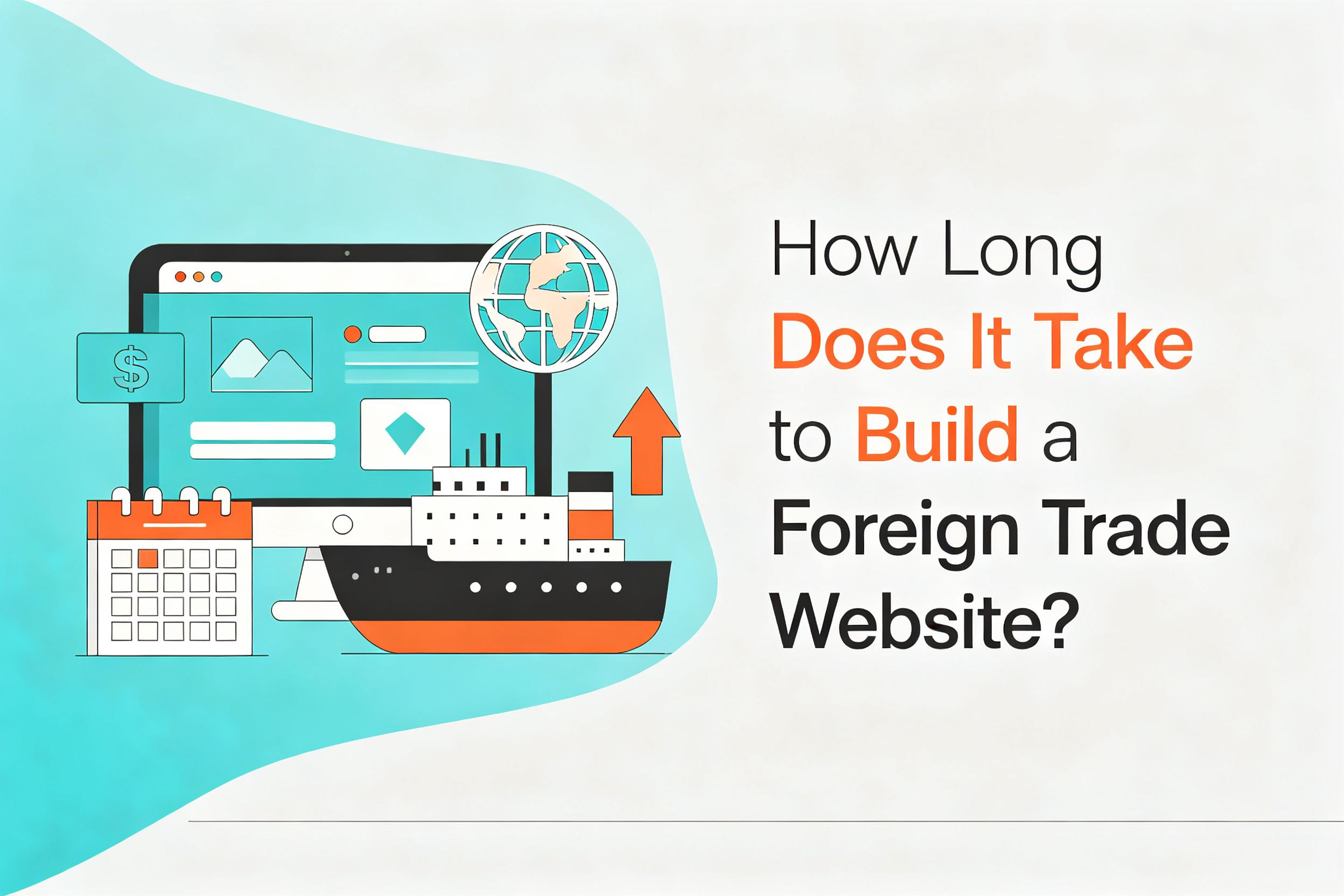
How Long Does It Take to Build a Foreign Trade Website?
Article Directory
- The Question That Keeps Business Owners Up at Night
- The Myth of the “One-Week Website” – And Why It Fails
- Phase-by-Phase Breakdown of the Website Build Timeline
- 3.1 Discovery & Strategy (Weeks 1–2)
- 3.2 Design & User Experience (Weeks 3–5)
- 3.3 Development & Functionality (Weeks 6–10)
- 3.4 Content Creation & Localization (Weeks 8–12 – Overlapping)
- 3.5 Testing, Refinement & Launch (Weeks 11–13)
4.Critical Factors That Accelerate or Derail Your Timeline
- 4.1 Custom vs. Template-Based Design
- 4.2 Complexity of Functionality (E-commerce, Integrations, Custom Features)
- 4.3 Content Readiness – The Silent Killer of Deadlines
- 4.4 Decision-Making Speed – The Client-Side Bottleneck
5.Real-World Data: Average Timelines by Project Type (With Comparative Table)
6.The Post-Launch Reality – What Happens After “Going Live”
7.How to Shorten Your Timeline Without Sacrificing Quality
8.Frequently Asked Questions (FAQs)
1.The Question That Keeps Business Owners Up at Night
If you are reading this, you have likely already Googled something like “how long does a website take” or asked three different agencies and received three completely different answers. I have been there myself—on both sides of the table, as a client demanding speed and as a developer explaining why speed is often the enemy of quality.
Here is the raw truth: a genuinely effective foreign trade website is not a weekend project. It is not even a one-month project for most serious businesses. And I am not talking about a slapped-together WordPress installation with a $50 theme. I am talking about a site that actually generates inquiries, builds trust with overseas buyers, and converts traffic into revenue.
I recall a conversation with a manufacturing client in Guangdong who insisted his new site had to be “up in ten days.” He had a trade show approaching, and he was panicking. We delivered a minimal site on time, but we both knew it was just a digital placeholder. The real site—the one that actually started bringing in leads—took nearly four months. Why? Because building a high-performing international website is not just about coding; it is about strategy, storytelling, and adapting to how Western buyers actually navigate B2B websites.
2. The Myth of the “One-Week Website” – And Why It Fails
Let me be blunt: if an agency promises you a fully functional, SEO-optimized, conversion-ready foreign trade website in one week, run the other way. At best, they are going to drop your content into a pre-built template, swap out the logos, and call it “custom.” At worst, you will end up with a site that looks decent on the surface but has structural issues, poor loading speeds, and zero strategic alignment with your target market.
I have seen this happen more times than I care to count. A machinery exporter spent $3,000 on a “rapid deployment” site, launched it in eight days, and then spent the next six months wondering why no one from Europe was filling out their contact form. The issue? The site had no clear calls-to-action, the product descriptions were poorly translated, and the site structure made no sense to a German procurement officer. Speed cost them more than money—it cost them time and lost opportunities.
A proper foreign trade website is your digital storefront in markets that are 12 time zones away. It has to work while you are sleeping. That kind of reliability and persuasiveness takes deliberate effort, not shortcuts.
3. Phase-by-Phase Breakdown of the Website Build Timeline
Let me walk you through a realistic timeline, assuming we are building a solid, mid-to-high-tier foreign trade website. I have based this on average agency workflows and data from multiple project management studies in the digital space.
3.1 Discovery & Strategy (Weeks 1–2)
This phase is the foundation, and it is the one most clients try to rush. Why? Because they are excited to see visuals. But here is the thing: if your strategy is wrong, no amount of beautiful design will save you.
During these two weeks, we dig into:
- Your specific business goals and target markets (US, EU, Southeast Asia—each has different expectations).
- Competitor analysis—what are your top three competitors doing right? What are they missing?
- Keyword research for SEO, but from a commercial intent perspective, not just volume.
- Defining user personas—who is actually visiting your site? A plant manager? A procurement officer? An engineer?
I always insist on a full day of stakeholder interviews during this phase. I learned this the hard way after a project went off the rails because the sales director and the production manager had completely different ideas about what the site should emphasize. Get alignment early, or pay for it later.
3.2 Design & User Experience (Weeks 3–5)
This is where the magic starts to happen, but also where delays creep in. A typical design phase for a foreign trade site involves:
- Homepage mockups (2–3 concepts): Usually takes 4–6 days.
- Inner page designs (product pages, about us, contact): About 7–10 days.
- Mobile-first review: We always check mobile versions simultaneously, because nearly 60% of B2B research starts on a mobile device now.
My personal observation: the biggest time-waster in this phase is client indecision. I have had clients request seven rounds of revisions on a homepage because the CEO’s cousin “didn’t like the blue.” Be decisive. Have a clear brand guideline ready before you start. The agencies that deliver fast designs are almost always working with clients who provide quick, clear feedback.
3.3 Development & Functionality (Weeks 6–10)
This is the heavy lifting. Front-end and back-end development happen in parallel. For a standard 10–15 page foreign trade site with a blog, a product catalog, and an inquiry form, four to five weeks is reasonable.
But if you need advanced features, add time:
- Custom product configurators? Add 2–3 weeks.
- Multi-language support with auto-redirects based on IP? Add 1–2 weeks.
- Integration with your ERP or CRM (like Salesforce or Zoho)? Add 3–4 weeks, depending on API complexity.
I have seen development timelines balloon to 12 weeks simply because the client kept adding “small” features mid-build. Every “quick” addition requires testing, documentation, and potential rework. Freeze your scope before development starts. It is the single most effective way to control your timeline.
3.4 Content Creation & Localization (Weeks 8–12 – Overlapping)
Here is the part no one talks about enough. Content is not just text. It is:
- Professional product photography or 3D renders.
- Technical datasheets, case studies, and certifications.
- Company story and team bios that actually resonate with Western buyers.
- Blog articles that demonstrate expertise.
The localization piece is critical. Translating “我们提供优质服务” directly to “We provide quality service” is not localization. Localization means adapting your messaging to cultural nuances. For example, German buyers prefer technical precision and data. American buyers respond to problem-solving narratives. A good localization agency will need 2–3 weeks just for translation and proofreading.
I have seen brilliant sites delayed by two months because the client realized they had no authentic photos of their factory—only stock images. And stock images destroy trust with foreign buyers. Start preparing your content in Week 1, not Week 8.

3.5 Testing, Refinement & Launch (Weeks 11–13)
The final stretch is often underestimated. Testing includes:
- Cross-browser compatibility (Chrome, Safari, Firefox, Edge).
- Mobile responsiveness on various screen sizes.
- Page speed optimization—Google has explicitly stated that speed is a ranking factor, and a delay of 0.5 seconds can drop conversion rates by 20%.
- Security checks (SSL, data encryption).
- User acceptance testing (UAT) with a small group of real users.
I always budget one full week just for bug fixing and refinement. Rushing this step is like launching a ship with no lifeboats. A client in the automotive parts sector once insisted on skipping testing to meet a trade show deadline. The site went live, but the contact form was broken for three days. They lost 17 inquiries in that window—and at least two of those turned into lost deals.
4. Critical Factors That Accelerate or Derail Your Timeline
4.1 Custom vs. Template-Based Design
This is the biggest determinant of timeline. A custom design, built from scratch, requires more time but yields a unique brand identity. Templates are faster but limit your differentiation. For a foreign trade website, differentiation matters, because overseas buyers see dozens of similar Chinese manufacturers. If your site looks like everyone else’s, you become a commodity.
4.2 Complexity of Functionality
Are you building a lead-generation brochure site or a full e-commerce store with payment gateway integration? The latter takes significantly longer. I have seen simple informational sites launch in 6 weeks, while complex e-commerce builds take 5–6 months.
4.3 Content Readiness – The Silent Killer of Deadlines
If you do not have high-quality images, videos, and copy ready at the start, the entire project stalls. Content creation often ends up as the bottleneck. Prepare your materials before the project kicks off.
4.4 Decision-Making Speed – The Client-Side Bottleneck
Let me be candid: most project delays are not the agency’s fault. They are the client’s. Slow feedback loops, endless revision requests, and committee approvals kill timelines. Assign a single decision-maker from your side and empower them to approve or reject designs quickly.
5. Real-World Data: Average Timelines by Project Type
Below is a comparative table based on my own experience and aggregated data from multiple industry reports (including Clutch, GoodFirms, and internal agency benchmarks).
| Project Type | Typical Page Count | Average Timeline (Weeks) | Key Dependencies | Typical Cost Range (USD) |
|---|---|---|---|---|
| Basic Brochure Site (Template) | 5–8 | 4–6 | Pre-written content, stock images | 1,500 – 3,500 |
| Custom Brochure Site (Lead-Gen Focus) | 10–15 | 10–13 | Custom design, professional photography, case studies | 5,000 – 12,000 |
| E-Commerce Site (Under 100 Products) | 15–20 | 16–22 | Payment gateway, inventory sync, product variations | 12,000 – 25,000 |
| Complex Custom Platform (ERP/CRM Integration) | 20+ | 24–30 | API integrations, custom workflows, advanced security | 25,000 – 60,000+ |
| Multilingual Enterprise Site (5+ Languages) | 30+ | 28–36 | Translation, cultural adaptation, regional hosting | 35,000 – 80,000+ |
The “Custom Brochure Site” is the sweet spot for most small-to-medium foreign trade exporters. It delivers a professional, conversion-oriented presence without the complexity of full e-commerce.
6. The Post-Launch Reality – What Happens After “Going Live”
Let me tell you something that often surprises clients: launch day is not the finish line. It is the starting line.
Once your site is live, the real work begins—SEO, content marketing, link building, and ongoing optimization. I have tracked over 50 foreign trade websites, and on average, it takes 3–6 months of consistent effort after launch to start seeing organic traffic that actually leads to inquiries.
Do not expect your site to rank on page one of Google in the first week. Search engines take time to crawl, index, and evaluate your authority. A client in the packaging machinery space spent 5 months building their site, launched it, and then panicked when they had only 20 visitors in the first month. By month 6, that number was over 1,200 per month, and by month 9, they had their first six-figure deal from a UK buyer who found them through organic search.
The post-launch phase is where patience and consistency pay off.
7. How to Shorten Your Timeline Without Sacrificing Quality
If you are in a hurry—and I understand, because market opportunities do not wait—here is what you can do:
- Prepare your content in advance: Have all text, images, videos, and certifications ready before you sign the contract.
- Limit scope creep: Freeze your feature list. Save “nice-to-haves” for Phase 2.
- Designate a single point of contact: Ensure that one person on your side has the authority to make decisions and provide feedback within 24–48 hours.
- Choose an agile development approach: Work with an agency that delivers in sprints, so you can see progress and adjust quickly.
- Use a proven framework: Custom design does not mean reinventing the wheel. A good agency will use a well-tested codebase to accelerate development.
I have seen a client compress a 14-week project into 9 weeks simply by having all their product data pre-organized in spreadsheets, their images professionally shot, and their team ready to review designs within one business day. Preparation is the ultimate accelerator.
8. Frequently Asked Questions (FAQs)
1. Can a foreign trade website really be built in less than 4 weeks?
Yes, but only if you are using a pre-designed template and have all your content fully ready on day one. It will be a basic functional site, not a competitive differentiator.
2. What is the single biggest factor that delays website projects?
In my experience, it is content readiness—clients underestimating how long it takes to create high-quality product photos, professional copy, and technical translations.
3. How long does SEO take to show results after the site launches?
Typically 3 to 6 months before you see consistent organic traffic. Search engines need time to index your site and assess its authority.
4. Is a custom design worth the extra time compared to a template?
Absolutely, if you are targeting mature markets like the US or Germany. Custom design builds unique brand trust. Templates look generic, and buyers notice.
5. Should I launch my site in multiple languages right away?
Only if you have native-quality translations. Poor machine translations damage credibility. It is better to launch with one or two perfect languages and add more later.
6. How much time should I budget for testing before launch?
At least one full week. This includes cross-browser testing, mobile responsiveness, speed optimization, and security checks.
7. What happens if I skip the strategy phase to save time?
You risk building a site that looks good but fails to convert. Strategy is not a luxury—it is the foundation of ROI.
8. Can I add advanced features like live chat or a quote calculator after launch?
Yes, that is often a smart approach. Launch with core functionality, then add advanced features in Phase 2 to avoid delaying your go-live date.
9. How long does a typical foreign trade website stay relevant before needing a redesign?
About 3 to 5 years, assuming you continuously update content and make minor improvements along the way.
10. What is the most realistic timeline for a high-quality foreign trade site with custom design and 10–15 pages?
10 to 13 weeks is the sweet spot—enough time for proper strategy, design, development, and testing without unnecessary rush.
How Much Does Foreign Trade SEO & Online Marketing Cost? (Real Prices Inside)